.png)
“František Prokop, 30 years old, a former private employee of a Bratislava factory, was fired from the factory for various machinations. When he had exhausted all his sources of income, he specialized in extortion. First of all, he wrote a letter to Štefan Čermák, an official of the health insurance fund, that if he did not immediately pay him 10,000 CZK, he would report him for forging various vouchers. […] Prokop wrote a second threatening letter to the manager of the Lyon silk store Schwarz, in which he invited him to appear at a certain day and hour at a Brno café, where they supposedly had to talk about a delicate matter. In this letter, Prokop threatened Schwarz that if he did not come to Brno, he would report him to the police for homosexuality. Schwarz ignored the blackmail letter and when Prokop came to threaten him in person, Schwarz called the police and filed a criminal case against him announcement," the National Newspaper wrote in 1928 in the From the Courtroom column.
The case of František Prokop ended in court: for extortion he received a sentence of "3 years in prison without parole". However, such an outcome was not a given. Many cases of extortion associated with the victim's real, presumed or purposefully insinuated homosexual orientation did not end with a fair punishment of the extortionist. On the contrary, they often had serious consequences for the people being blackmailed: psychological exhaustion, a threat to their reputation, loss of job or career. As early as 1924, the National newspaper laconically noted in similar cases: "In this way, they allegedly drove one person to suicide."
Between the law, shame and blackmail
In interwar Czechoslovakia, laws were in force that punished intimate relations between persons of the same sex with sentences ranging from one to five years in prison. The criminalization of homosexuality created an environment in which a person could be threatened even when no evidence was found against them. All it took was a suspicion, an insinuation, gossip, or a threatening letter.
The perception of homosexuality at the time was made up of several layers of prejudice and power pressures. In church circles, it was often described as a sin, in medical circles as a deviation or disorder that required treatment, and police and judicial authorities acted according to the articles. In wider society, the prevailing idea was that it was something forbidden, inappropriate, and threatening the order and morality of the time.
In such an environment, it was very difficult to speak publicly about love, desire, or an identity that went beyond the expectations of the majority. It was even more difficult to talk about it in the family, at school, or at work. People with homosexual orientation therefore often lived a life that they could not experience openly and in harmony with themselves. Many suffered because of their feelings, some tried "treatment", others tried lifelong celibacy. A large part of them entered into marriages because their family and society expected it of them. The result was a double life, pretense, loneliness, and unfulfilled expectations on both sides of the marital relationship.
The contemporary press intensified this pressure. Articles about homosexuality appeared in local and national newspapers, especially in connection with police investigations, court hearings and verdicts: “Homosexual Fodor confessed”, “Lučenec homosexuality before the court”, “New homosexual scandal in Nitra”. Gays and lesbians of the time could read about themselves that what they felt or wanted to express was “depraved”, “perverse” and “deviant”. These are words that have not completely disappeared from public discussions about the rights of LGBT people even after a hundred years. Newspaper rhetoric almost always worked with scandal, sensation and moral outrage. The city was supposedly “excited”, the public was outraged and the case was presented as evidence of “decline in morals”.
Treatment as another form of pressure
One of the paths that families or the people affected in this situation chose was treatment. Parents often encouraged their sons to undergo therapy, the aim of which was to “change sex”. For this purpose, they visited clinics in Prague, Bratislava or Vienna. However, the surviving testimonies show that these attempts did not bring about a change of orientation, but rather an additional layer of shame, fatigue and economic burden.
A young official with the initials KJ, for example, underwent treatment in the form of suggestion and hypnosis at a Bratislava clinic. He went to outpatient clinics for half a year, but felt no change and finally considered the whole process useless. In order to finally stop the treatment, he told the doctor that he had "cured himself of homosexuality and already feels love for women."
Another young man, a graduate of the Žilina secondary school, who went by the initials RI, became a victim of blackmail. As a result, his family and those around him learned about his orientation. At his mother's insistence, he underwent psychoanalytic treatment in Vienna with Wilhelm Stekel. It lasted almost three quarters of a year and cost him a considerable amount of money. Like KJ, he finally told the doctor that he was cured, loved women, and did not need further treatment. In reality, however, he described the entire process as "terribly embarrassing," financially demanding, and without any results. Nevertheless, Stekel cited his case in a Viennese medical journal as successful proof of the treatment of homosexuality through psychoanalysis.
The case of Pavol S., a graduate of the Bratislava Business Academy, is also telling. His neighbors reported him to his mother as a “Männerjäger” – a man hunter. At her insistence and on the recommendation of a well-known doctor, he visited a Viennese clinic and underwent therapy for a long time. According to his own words, it did not bring any results, and he even stated that “he was even more eager for handsome students”. When the “medical” expenses climbed to 12,000 CZK, he told the doctor and his mother that he was cured. From the available sources, we know that Pavol S. eventually fell in love unhappily and ended his life by drowning in the Danube.
These stories show that the criminalization and pathologizing of homosexuality did not exist separately. The law, family pressure, medical authorities, newspaper rhetoric, and social shame created a single system. A person did not have to find himself in court to be punished. Sometimes it was enough to be afraid of being in court or in the public eye at all.
First votes for change
At that time, professional opinion was largely in line with the common social perception of homosexuality. Nevertheless, people gradually appeared in medical and legal circles who began to reconsider established views. Their motivations could be varied: professional interest in new research topics, humanistic beliefs, experience with specific cases, or legal sensitivity to injustice. However, they were united by one goal: decriminalization.
Even Czechoslovak doctors who advocated change in the interwar period did not agree on everything. They had different ideas about the origin and causes of homosexuality. However, they brought new arguments to the public debate and tried to push for the abolition of the general criminalization of homosexual relations. In Bohemia, they included, for example, psychiatrist Hugo Bondy, and in Slovakia, doctor Karol Matulay, later known as a prominent psychiatrist and neurologist.
Similar voices were also heard from legal circles. Already in the early 1920s, opinions emerged that the articles punishing same-sex intercourse with imprisonment were barbaric and in practice facilitated a culture of extortion. After its establishment, Czechoslovakia operated in a dual legal model: in Bohemia and Moravia, Austrian criminal legislation remained in force, and in Slovakia, Hungarian. This situation was supposed to be temporary and was to be changed by the prepared legal reform. One of the commissions prepared studies that argued in favor of decriminalization and proposed the abolition of the articles punishing same-sex intercourse between adults. However, the adoption of new criminal legislation did not occur during the interwar republic due to the lengthy trials.
The voice of love
Civil society also spoke out in favor of decriminalizing homosexuality – in today's terms. They included representatives of the intellectual elite, writers, artists, people from the middle class of civil servants, but also representatives of the "sexual minority" themselves. At the time, they called themselves "minority people" and began to speak for themselves.
"...same-sex loving persons, who even in today's progressive era are condemned by priests of all religions as sinners, judged by judges as criminals, and some people are pitifully considered sick. Thus, homoerotics are rebuked as sinners, despised as criminals, pitied as sick, while their enemies are unanimous in their support: punishing and eradicating same-sex lovers. But objective, scientific research, which subjected same-sex lovers to strict, thorough and factual examination, has established them as proper, decent, dignified people. What's more, it has been proven that among them there are also valuable components of civilization, culture, progress...", wrote Imrich Matyáš, one of the minorities, a Slovak official and a pioneer in efforts to abolish the criminalization of homosexuality.
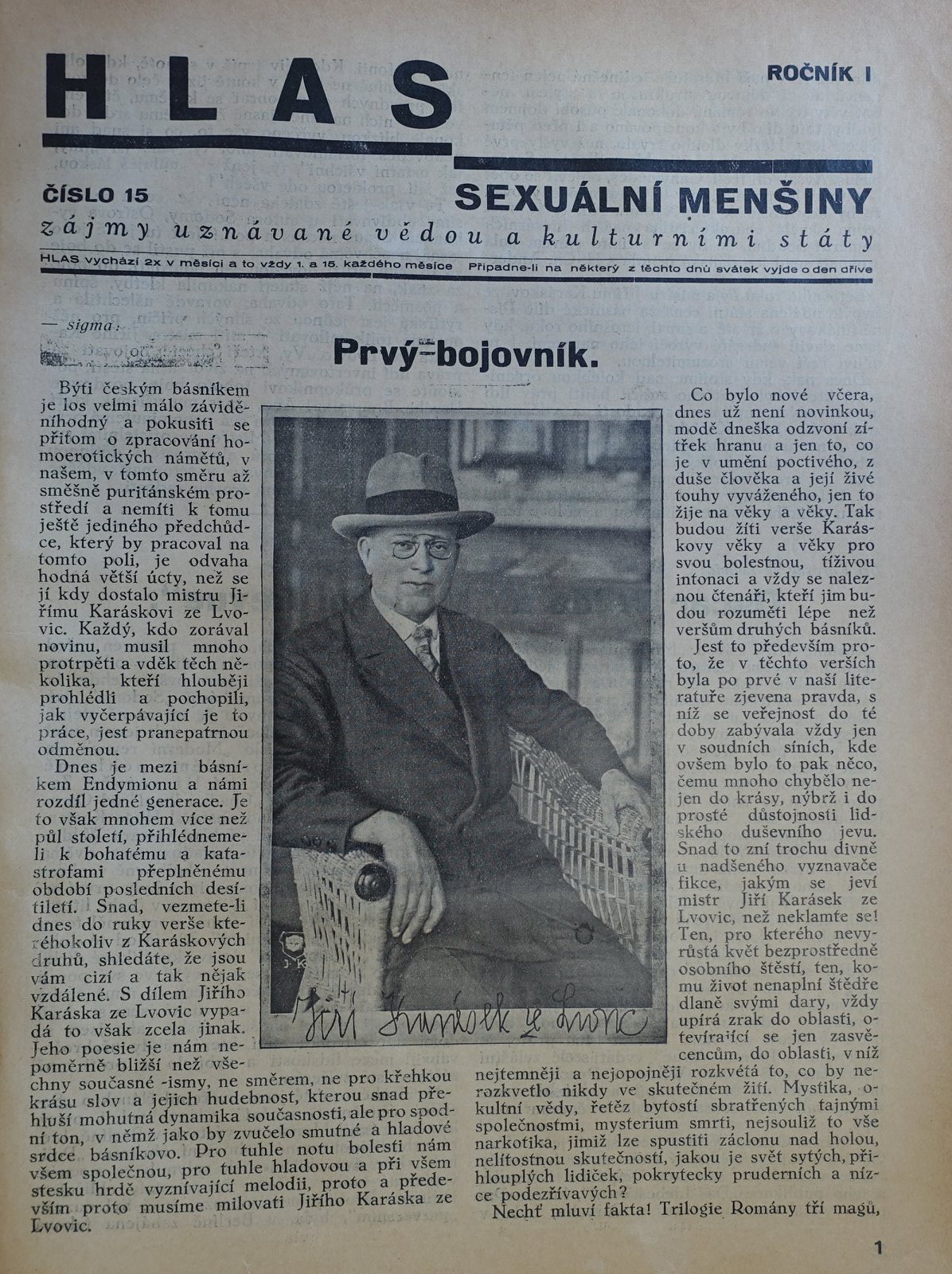
In 1931, the magazine Hlas sexuální menšiny (Voice of the Sexual Minority) began to be published in Prague, later Nový hlas (New Voice) and Hlas přírody (The Voice of Nature), which was published intermittently until 1938. It was founded by a group of committed people, mainly from the LGBT community of the time. They no longer wanted to stand idly by and watch the injustice and undignified position of “homoerotics”. Their arguments were based on current scientific research, especially the work of sexologist Magnus Hirschfeld and his colleagues from the Institute of Sexual Science in Berlin, founded in 1919.
Hirschfeld argued that homosexuality was not a disease, but a natural form of human sexuality that could not be changed by any means. If someone attempted such a change, they could only change their behavior, often only temporarily, not their feelings. During his practice, he met homosexual men and women from different classes, education, characters, and countries. He came to the conclusion that they had nothing in common except the fact that they were born homosexual. He therefore asked whom these people were threatening in their mutually consenting expressions of love, and why they should suffer punishment for seeking happiness and self-fulfillment like any other person.
Magnus Hirschfeld visited Czechoslovakia several times. At the invitation of Imrich Matyáš, he also came to Bratislava, where he lectured in the Reduta building on the need to reconsider the view of homosexuality from a scientific point of view. His slogan – achieving justice through science – also captured the broader ambition of the movement. It was not just about changing the paragraphs, but also about changing the language used to talk about human sexuality.
Hlasists, inspired by the German movement, published texts that were completely different from the media discourse of the time. Lawyer František Čeřovský wrote well-argued glosses on the need to abolish punitive articles. Jana Mattuschová called on gays and lesbians of the time to join the ethical effort for social change. In addition to activist and legally oriented articles, Hlas also published short stories, poems, and personal texts.
Based on the reactions of readers from different parts of the republic, the editorial staff decided to establish a written advice center. People confided in it about their experiences with blackmail and asked for help. Young women and men wrote about how to talk to their parents about their orientation, or asked what they could do to live authentically and in accordance with "their foundation". Hlas also offered a dating column. In the 1930s, Czechoslovak lesbians and gays thus gained a greater opportunity to get to know each other. And even those who did not take advantage of this opportunity could, thanks to the advice center, columns and poems, feel that they were not alone or isolated in their search.
Matyáš and work for the community
Imrich Matyáš wrote that despite the persecution, the hardships of the sections and the shame that society, the church and the laws caused in these people, there is hope for a good life. He did not understand his work only as journalism or enlightenment. He was also concerned with concrete help for people from the community and creating a support network.
He tried to recruit experts, such as the doctor Karol Matulay, but also other people who could publicly or professionally support the abolition of the punitive paragraphs. He also specifically addressed people from the community working in professional positions to help with awareness, legal arguments or concrete assistance. He did not always meet with understanding. For example, one university professor, whom Matyáš knew was gay, told him not to bother him because he did not want to have anything to do with "those". Matyáš bitterly noted that he then "conspicuously vented his anger on his fellow tribesmen".
The planned legal reform ultimately failed to materialize. At the end of the 1930s, the republic found itself under threat from both outside and inside. After World War II, the legislation was changed only after the communist coup, but the new criminal law of 1950 continued to punish homosexuality. Union activity and the publication of a magazine like Hlas were no longer possible. Homosexuality once again became a topic suitable for blackmail, pressure, and political abuse.
In the early 1950s, Matyáš was regularly summoned for interrogations. Investigators tried to obtain information from him about people from the homosexual community, especially those who might have connections to the Democratic Party or were potentially blackmailable and thus usable in political games. The interrogations mentally exhausted him, but he did not succumb to them and did not "lend himself" to cooperation. He later wrote: "Their efforts to force me to betray those for whom I had been advocating for almost 40 years were in vain! They did not achieve their goal, so they sent me out of the room with the words 'get out...you...'."
Even after these experiences, he did not stop his educational work. He continued to give private lectures and wrote letters to the Ministry of Justice, demanding an amendment to the Criminal Code and the repeal of anti-homosexuality sections.
From failed attempts to change orientation to changing the law
In the mid-1950s, psychiatrist and sexologist Kurt Freund from the Psychiatric Clinic of Charles University in Prague, together with colleagues, notably Karel Nedom, conducted research focused on the alleged possibilities of changing orientation in homosexual men. Participation in the research was voluntary and in the end almost 300 men took part. The lesbian women interviewed showed no interest in similar experiments.
The experiments were drastic. Participants drank tea or coffee laced with emetine, a substance that induces vomiting, then a doctor injected emetine into their veins and projected images of scantily clad men onto a wall, asking them to imagine them as sexual partners. In another experiment, they were injected with a male hormone and then projected images of scantily clad women.
Freund was optimistic at the beginning of his experiments. However, based on the results and interviews with the people concerned, he concluded that these methods did not lead to a change in orientation. An important result of his research was also the conclusion that voluntary intimate contact between adults of the same sex poses no danger to society and that continued criminal sanctions are unnecessary.
It was Kurt Freund and Karel Nedoma who made significant efforts to ensure that these conclusions were reflected in legislative practice. In 1961, Section 241, which penalized same-sex intercourse between adults, was repealed. Matyáš welcomed this step very much. His estate also preserved copies of letters addressed to Freund and Nedoma, in which he asked them to advocate for change, and attached to them the argument he had cultivated for years, based on Hirschfeld's research.
Reverberations of the First Republic
Today's question "why doesn't he admit that he is gay?" is also a relic of the times when homosexuality was criminalized. In an environment where confession could mean investigation, loss of job, family rejection, blackmail or public humiliation, silence became a survival strategy. The history of LGBT people cannot therefore be understood only through the question of visibility. It is also necessary to ask about the price that visibility had in a specific historical period.
After the adoption of the new criminal code in 1961, the perception of gays and lesbians in society changed only very slowly. Articles that presented homosexuality as something foreign continued to dominate the media discourse, for example the headline "America, the World of Homosexuals" in Večerník in 1967, or articles written in a spirit similar to the interwar press. Only rarely did a text appear, such as the article "Žijí mezi námi" in Mladý svět from 1972, in which the author refuted several widespread prejudices.
A more real shift and the possibility of continuing the federal activity of the First Republic came only in 1989. In 1990, the criminalization of homosexuality was completely abolished and the age of legal sexual intercourse was equalized to 15 for everyone. In Slovak conditions, this was the last legislative change for a long time that influenced the lives of "same-sex lovers" for the better.
Stories of blackmailed men, failed treatment attempts, whistleblowers, counseling, letters and interrogations remind us that the history of LGBT people is not just a history of paragraphs. It is also a history of everyday fear, ingenuity, solidarity and courage. And at the same time, the history of people who, despite the pressure of their time, insisted that the right to dignity, love and a good life should not be postponed until later.
Sources
Matyáš, Imrich: Sexual life in the light of science with criticism of certain sections of the criminal law. Volumes 2–8 (with the exception of the lost volume 5). Notes, reflections, diary entries.
Seidl, Jan et al.: From the dungeon to the altar. Emancipation of homosexuality in the Czech lands from 1867 to the present. Guest, Brno 2012.
National newspaper, May 17, 1924, No. 113.
National newspaper, August 21, 1927, No. 190.
National newspaper, March 16, 1928, No. 64.
Slovak, January 20, 1928, No. 16.
Slovak newspaper, February 19, 1932, No. 41.
Slovak Nation, independent autonomist newspaper, June 11, 1925, No. 31.
https://napotulkach.inakost.sk/
The text is a revised and edited version of an article originally written for the magazine Post Bellum – Stories of the 20th Century: The Same Love, 1/2024.