"You are homosexual, pay or else...!"
The audacity of low individuals knows no bounds. In recent days, a five-member party was arrested, which created an extortion company in Prague. The oldest of them, 43-year-old Antonín Lippert, who has already spent 20 years in prison, organized a fake police commissariat. Lippert introduced himself as detective Borkovec from the Prague police headquarters, the others as detectives. It goes without saying that they first set out to blackmail homoerotics. How many of them were in the "investigation" with their right hand outstretched and with the words "give" can't be determined, because the damage would rather give the extortionist the last coat, than expose themselves to the danger of suspicion by reporting the individual. Only § 129 allows villains to commit extortion crimes."[1]
And this was immediately followed by a call: "Nevertheless, it can happen to many that they fall into the clutches of these beasts among people. In that case, worry aside! Come the shortest way to the Voice's editorial office; we will take care of making the villain harmless."[2]
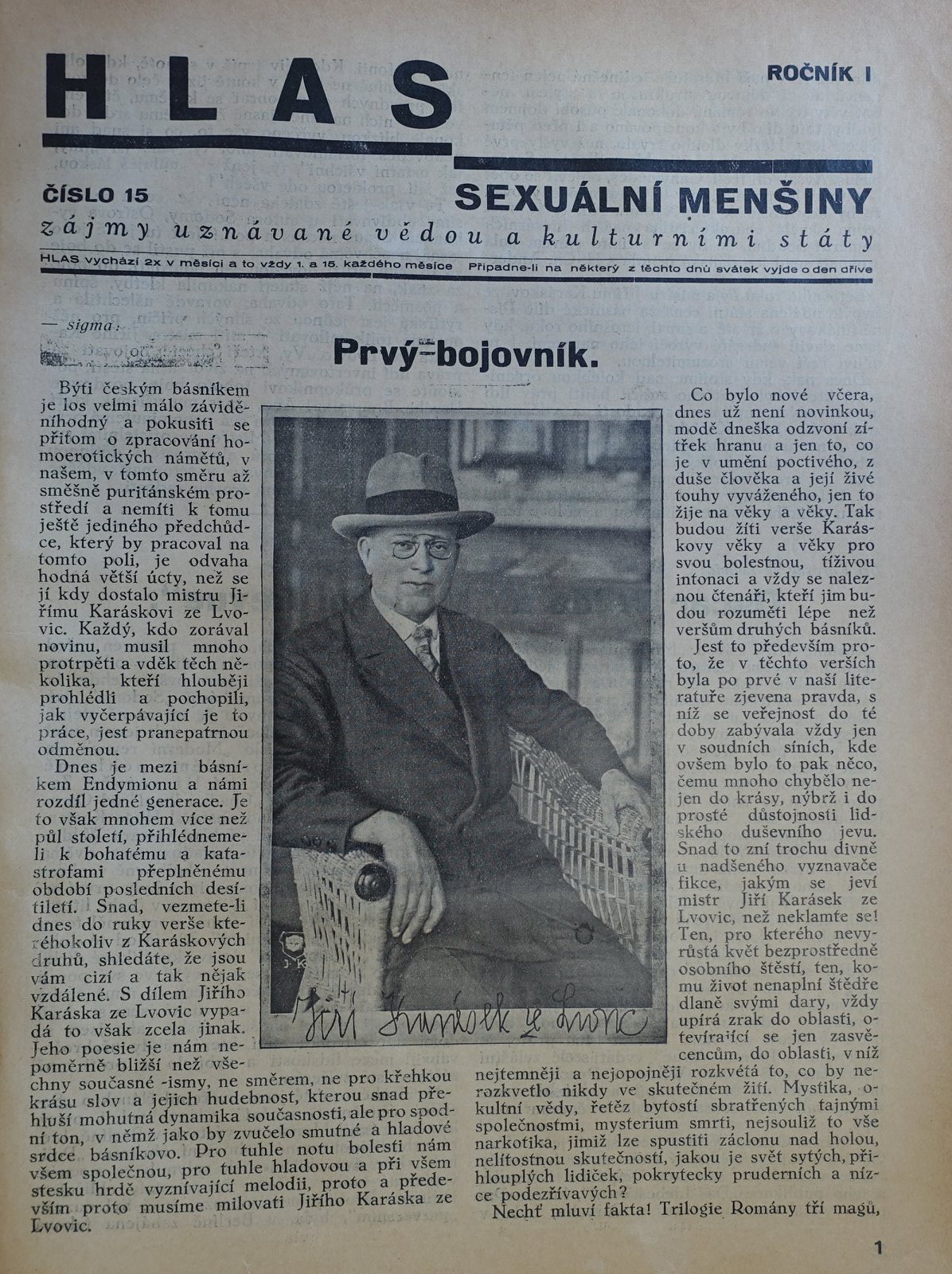
These words were published in 1936 in Hlas, a newspaper for sexual reform. It is not just a brief report on a single case of blackmail. It is also an accurate picture of a time when the law itself created conditions of fear, silence, and abuse. Intimacy between persons of the same sex was then a crime, and the penalty could be one to five years in prison.[3] In practice, although courts often imposed lesser sentences, the consequences could accompany a person for life: a damaged reputation, loss of job, inability to find employment in state or public administration, and a threat to pensions or social security.
For many, this meant a life of constant tension. All it took was a suspicion, an anonymous letter or a blackmail threat and a person could become a “case.” It was in this environment that a magazine was born, which decided to speak out about what, according to the morality of the time, should have remained hidden.
The law that created fear
As early as the 1920s, attempts were made in Czechoslovakia to establish an association that would draw attention to the injustice of the penal codes and strive for the decriminalization of homosexuality. However, the authorities did not allow such an association. What the association failed to achieve, the press began to do in the early 1930s: the Voice of the Sexual Minority was established, the first press organ of people who at the time referred to themselves as "sexual minorities" or "minorities".
At first glance, it was an inconspicuous magazine. Its visuals were not flashy and the publishing conditions were modest. However, in terms of content, it was a bold, modern and provocative project. Its goal was clear: to abolish the paragraphs that destroyed the lives of many people, to eliminate prejudice against homosexual and bisexual people, and to create a community of people around the magazine who cared about the reform of society.
An unobtrusive magazine with big ambition
The magazine was founded in 1931 by brothers František and Vojtěch Černí. They also started publishing it because, in their own words, "numerous reasonable people" convinced them that such a magazine made sense and would have support. However, they realized from the beginning that if it was to be published regularly, process suggestions from readers, and at the same time lead a public debate, it would not be possible to do it only on the sidelines of work and without financial support.
Hlas was not a narrowly specialized professional periodical. It was more like a social magazine, which brought together political texts, legal arguments, literary contributions, poems, short stories, feuilletons, news from abroad and advertising. The advertising section was of particular importance to the community. It enabled acquaintances, facilitated contacts and created a space in which people could at least indirectly make sure that they were not alone.
The magazine also ran advertisements for businesses, restaurants, and trades that were open to people of homosexual orientation. Sometimes because their operators or employees were themselves members of the community, sometimes simply because they were places where it was safer to meet than elsewhere. If civic engagement was to occur, a network of trust had to be established first.
A community that was still learning to be public
The most powerful texts were those that we can call mobilizing today. The editorial staff used them to appeal to readers not to remain passive, to support the magazine and join the common effort to change the law. This appeal was repeated in almost every issue. The Voice constantly struggled with a lack of money and called on “homoerotics” to contribute to its publication as a common cause.
The practical obstacles were not negligible. For example, the editorial staff spent considerable resources to send the magazine to subscribers discreetly, in a sealed envelope. This was more expensive than regular newspaper delivery, but for many readers it was a necessary condition. Publicly subscribing to such a magazine could mean suspicion, gossip, family conflict, loss of job or blackmail.
So the voice didn't just create a space for lyrics. It also created a protective space for people who lived between the desire for a dignified life and the daily fear of exposure.
Magazine as a tool for change
The editorial staff did not send the magazine only to paying readers. They also sent it free of charge to those they wanted to win over to support decriminalization: MPs, ministries, police and judicial organizations, lawyers, doctors, and prominent public figures. The magazine was intended to be an argumentative tool and at the same time proof that "sexual minorities" are not an isolated group of individuals, but a social issue.
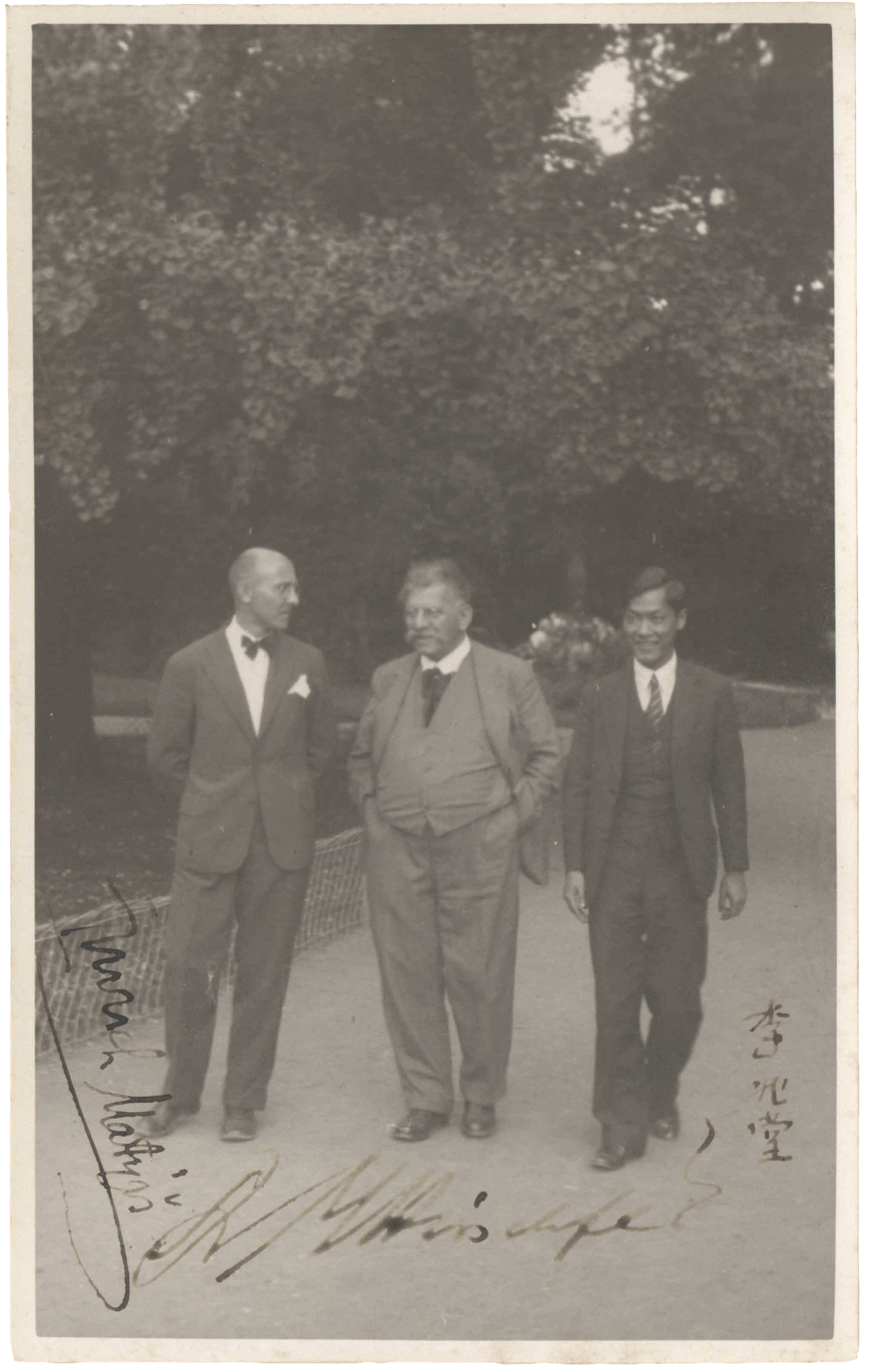
An important role in this was played by Imrich Matyáš (1896–1974), a Slovak civil servant, publicist and educational worker, who was entrusted with the management of the Slovak editorial office of Hlas. Matyáš sent the magazine to medical authorities in the field of psychiatry and the nascent sexology in Slovakia, to lawyers, courts, judges and other scientific authorities. He did this with the hope that the arguments published in Hlas would convince them and gradually contribute to a change in professional and public opinion.
In his texts, he emphasized that homosexuality is “nature, a state that cannot be changed in any way and never” and that its manifestations “are not harmful to anyone in the world.” This, he said, implied that it was a cruel injustice to downgrade these people, despise them, and consider them inferior or second-class citizens.[4]
Whether and how the authorities or individual authorities reacted to Hlas, we cannot say for sure today. However, Matyáš stated in his diaries and works that he managed to win over Karol Matulay, later a prominent Slovak psychiatrist and neurologist, and the lawyer Vojtech Hudec to his side. At a legal convention on the reform of Czechoslovak legislation, Hudec spoke out in favor of the criminalization of homosexuality, and his arguments were strikingly reminiscent of Matyáš's formulations. Finally, Matyáš and Hudec were also colleagues at the social security office.
When the first Voice was exhausted
The founders of the magazine were ultimately unable to overcome financial and organizational difficulties. The Černí brothers also tried to gain support at community parties where homosexual clientele met, and to collect the funds necessary for further publication. However, they ceased their activities in 1932.
However, the magazine's story did not end there. The efforts of the Černý brothers were taken over by a new editorial team, which did not want to accept that the demise of the magazine would also weaken efforts to emancipate homosexuality in Czechoslovakia. The name of Vojtěch Černý did not disappear from the history of Hlas; it would return to them once again.
A new voice: dignity instead of "cursed loves"
From 1932, the magazine continued under the name Nový hlas. It was led by an editorial board consisting of Jiří Karásek ze Lvovice (1871–1951), a well-known Czech poet and writer who was a role model and living legend for the community at the time, lawyer and advocate František Čeřovský (1881–1962), who did not belong to the community himself, but advocated for its rights until the end of his life, and Eduard Weingart, the literary pseudonym of Prague official Jana Mattuschová.
The new voice followed its predecessor in “uncompromising and firmness in defending the interests of our people and their rights to life and simple human happiness”.[5] At the same time, it sought to improve the quality of the texts and not base the magazine on personal disputes. This was probably also an allusion to the internal conflicts associated with the management style of the original editorial staff of Vojtěch Černý, which discouraged some people from getting involved.
In the New Year's contribution from 1933, it was therefore stated that Nový hlas would not be "a magazine of cursed loves, but of people who are gradually gaining recognition from human society and striving for full equality before society and before the law".
This shift is important. The editorial team didn't just want to talk about suffering, loneliness, or forbidden love. They wanted to talk about civic dignity, the rights, and the place of homosexual people in society.
Limits of your own time
However, Nový hlas also bore the marks of its time. Part of the editorial staff took a hard line against homosexuals who visibly transgressed gender norms or behaved in a way that, according to the editorial staff, damaged the public image of the entire community. The magazine was convinced that social recognition could be achieved mainly by cooperating with "normal" people, that is, in the words of the time, with the heterosexual majority.[6][7]
From today's perspective, this is a tense and problematic place. However, it shows that even emancipatory movements do not arise in a vacuum, outside of their social and political context. Even people who advocated for justice and equality often accepted the limits of the contemporary idea of acceptability, decency, and "dignified" representation of a minority.
After the Nazis came to power in Germany in 1933, Nový hlas gained another dimension. Since homosexual publications were banned in Germany, the Czechoslovak magazine became one of the last periodicals of its kind. The editorial staff therefore began to publish German texts in a separate supplement.
Why the New Voice disappeared
However, even Nové hlas failed to overcome weak subscriber interest and financial exhaustion. It closed in 1934. The editors later bitterly stated that many were more interested in the physical side of homosexuality than in political and social work, others feared discredit when delivering the magazine, the working class was not satisfied with scientific texts, and more educated readers were not satisfied with more popular content. "It was simply not possible to satisfy everyone in a limited scope," the magazine summarized its possibilities.[8]
Behind this sentence, one can sense disappointment, but also a very practical problem. Hlas and Nový hlas tried to do several things at once: to be a community magazine, a professional platform, a legal advice center, a literary space, a political tool, and a place of mutual encouragement. However, the magazine had only very limited financial, personnel, and social resources for such an ambition.
Return of Voice and Lost Numbers
In 1936, the original founder Vojtěch Černý (1893–1938) returned to the scene and resumed publication of the magazine under the name Hlas. List pro sexuální reformu. However, only the first issue from October 1936 is available for historical research today. Other issues published in 1936 and 1937 are no longer in the records of the National Library of the Czech Republic. They were last available before 1993. We do not know where they disappeared to or whether someone stole them. They have not been found to date and are considered lost.
The first issue of the renewed Hlas again mainly contained texts calling on people to join in defending their rights and support the repeal of anti-homosexual laws. It also included an article about the persecution of homosexuals in Nazi Germany. The editorial board considered dividing the magazine into two titles: one more professional, intended for political and scientific authorities, and the other community-oriented, aimed at homosexual readers themselves. However, this intention was not realized. In 1937, the magazine ceased to exist again, mainly for economic reasons.
Brno's Kamarád
In addition to the Prague Hlas, the Brno magazine Kamarád is also worth mentioning - a magazine dedicated to the interests of friendship recognized by science and cultural states, which was founded in Brno in 1932 by the Slovak painter Štefan Leonard Kostelníček (1900–1949). Only one issue has been preserved in the archives, so it is not certain whether, despite the publisher's ambitions, it was also the last, or whether more issues were published that have not been preserved.
Kamarád set itself similar goals to its Prague "older brother": to strive for the abolition of criminal articles, to eliminate prejudices about homosexuality, to motivate people from the community to get involved, and to provide them with legal and medical advice. It declared that it did not want to be a competitor to Hlas, but rather to strengthen joint efforts, and called on readers to subscribe to both magazines. However, according to several indications, the Prague editorial staff perceived Kamarád more as a fragmentation of forces and resources.
Imrich Matyáš also contributed his texts to Kamarád, as well as to all versions of Hlas. It is through his person that the Slovak mark in the history of the interwar homosexual press is very clearly visible.
Small numbers, great determination
Between 1931 and 1937, a magazine was published intermittently, which had no parallel in Czechoslovakia. It was bold, provocative, and modern. It combined political texts with literature, legal arguments with personal challenges, advertisements with feuilletons, and practical help with a vision of social reform.
Many authors wrote under pseudonyms or acronyms, which also shows how difficult it was at that time to publicly declare one's orientation or to advocate for the rights of a group that was often declassed and humiliated by the law, medicine, church, and public opinion.
We can no longer accurately measure the impact of The Voice on its readers. We cannot count how many people it gave hope to, how many read it secretly, how many it helped to understand their own experience, and how many dared to write, seek help, or join in a common effort.
But we know that it existed. And that in itself was not enough. At a time when the law allowed blackmail and society often forced people to silence, Hlas created a space where one could talk about dignity, rights, science, love, and human happiness.
Let us therefore leave the conclusion to Imrich Matyáš, one of the most qualified witnesses of this effort: "We were truly a small number who exposed ourselves almost exclusively with the mental weapons of science and humanity in favor of homoerotics. […] That small number of men and women who nevertheless stood in battle formation, stood their ground honorably and thereby earned justice and progress. They also deserve respect and undying gratitude, which - as I know them - they do not deserve."[9]
Footnotes
[1] Voice. Letter for sexual reform, no. 1, 1936, p. 12.
[2] Ibid.
[3] Section 129 of the Criminal Code punished same-sex intercourse with a sentence of up to 5 years in prison. As the newly formed Czechoslovakia continuously adopted Austro-Hungarian legislation, the young republic was governed by two legal systems: in Bohemia and Moravia, the Criminal Code was in force, which punished homosexual intercourse between men and women; in Slovakia, Section 241 punished same-sex intercourse between men, but did not apply to women.
[4] Matyáš, Imrich: Sexual life in the light of science with criticism of certain sections of the criminal law. Part VI, pp. 43-44.
[5] According to Seidl, Jan: From prison to altar. Emancipation of homosexuality in the Czech lands from 1867 to the present. Brno: Host, 2012, p. 169.
[6] In this context, this refers to heterosexual people. The term "normal" was used frequently in this press, but not in today's evaluative sense.
[7] According to Seidl, Jan: From prison to altar. Emancipation of homosexuality in the Czech lands from 1867 to the present. Brno: Host, 2012, p. 178.
[8] According to Seidl, Jan: From prison to altar. Emancipation of homosexuality in the Czech lands from 1867 to the present. Brno: Host, 2012, p. 189-190.
[9] Matyáš, Imrich: Sexual life in the light of science with criticism of certain sections of the criminal law. VII. part, pp. 42-43.