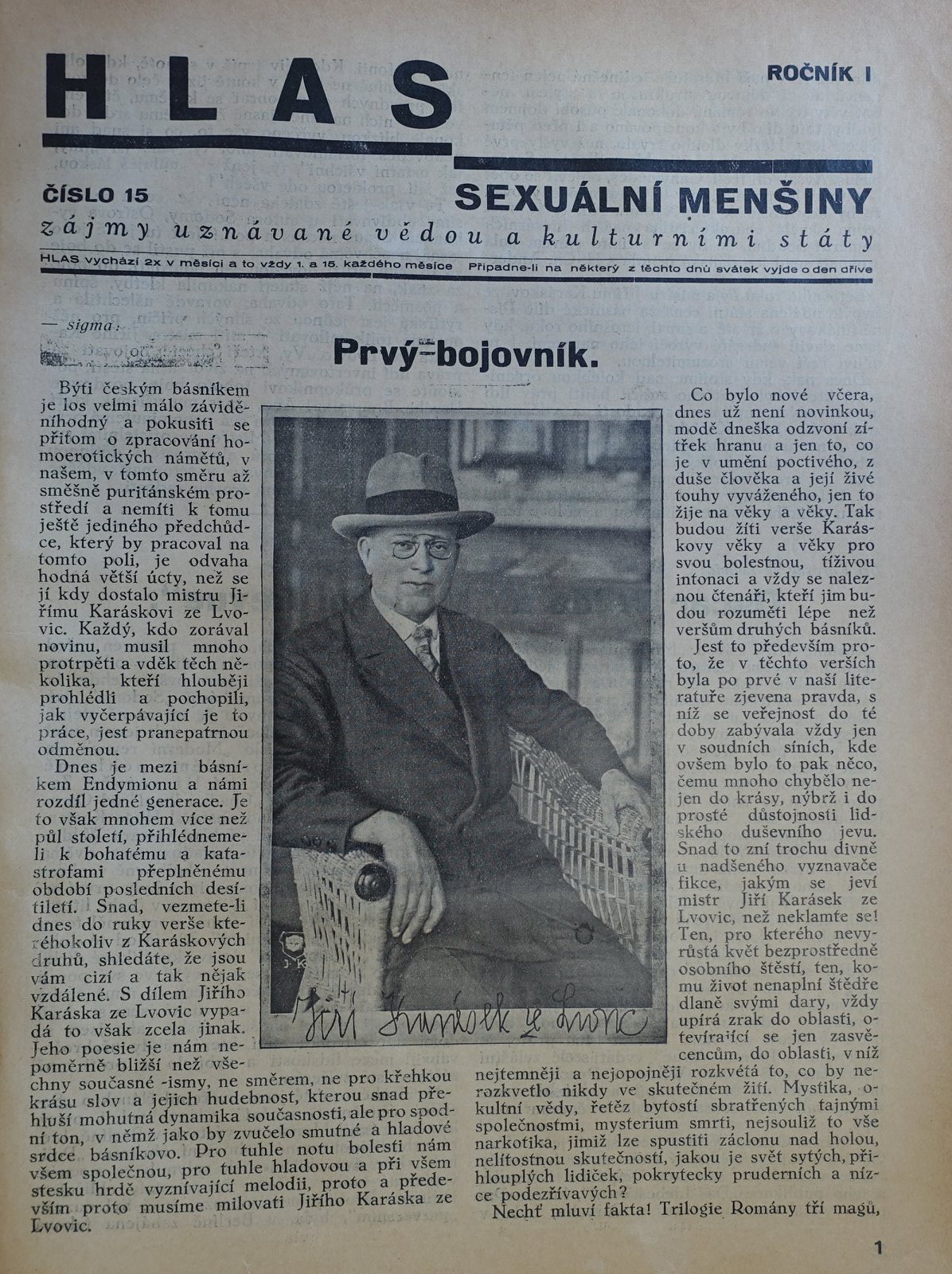
In 1925, several Bratislava newspapers reported on a “depraved businessman” who had allegedly seduced and sexually abused an “innocent young man.” The tone of the press at the time was unequivocal: the public expected the businessman to be convicted and sentenced “behind bars like a wild animal in a cage.”
If the case had not reached Imrich Matyáš, one of the most qualified people in Czechoslovakia at the time in the matter of defending “same-sex lovers,” this single version of the story would probably have remained in the archives. [1] However, the Bratislava businessman knew that Matyáš was publicly speaking out against the criminalization of homosexual people and asked him for help. [2]
The seemingly simple "affair" thus unfolds before us differently: not as a story of a corrupt adult and an innocent youth, but as a story of blackmail, fear, and the law, which could be abused against a person precisely because his intimacy was criminal.
Merchant's lures
Let's go back to the beginning. During one of his walks, a shopkeeper noticed a young man he didn't know. At first he just watched him, then followed him, and finally approached him. He asked for a cigarette and "1 crown." Out of compassion, the shopkeeper gave him what he asked for and considered the matter settled. The next day, however, the young man appeared again, this time right outside his apartment door. He demanded to speak to the merchant “in private.” The merchant had no idea what was going on and sent him to his shop, where they were to talk.
There, the young man got straight to the point. He asked for 100 crowns, adding that "it's better to borrow money without any hassle than for the police to find out about your affection." The businessman could have defended himself by saying that he was married. However, the fear of his true identity being publicly revealed outweighed him. He gave him the money.
The demands are escalating
His suffering did not end there. On the contrary, the young man escalated his demands. He asked for more money, and later for a share of the sales, he went to his place for lunch as an "invited friend", he broke into his apartment as a frequent visitor and overnight guest, he wore his suits and supported his mistresses with his money.
The young man knew well that the criminalization of homosexuality was his most effective weapon. He relied on the businessman not to go to the police, as this could jeopardize his own reputation, business, and social standing.
The whole affair lasted more than half a year. Then the young man decided to go even further: he began an affair with the businessman's wife, who agreed to it. The financially devastated and mentally exhausted businessman finally couldn't stand it and threw the blackmailer "on the pavement".
However, he regretted his action the very next day. He found that the local press had begun to cover up the case; one newspaper even published his initials. In Bratislava at that time, it was not difficult to find out who it was. The businessman found himself in despair and even thought about suicide. That's when he turned to Matyáš and told him the whole story.
In the Bratislava underworld
Matyáš took on the case almost like a detective. "In a short time, I managed to get to know two friends of the blackmailer," he writes. "One of them told me for 20 CZK that the young man, whom XY the merchant supports, had injured his genitals with a nail and had contracted a venereal disease from a certain prostitute, whom he supported with the merchant's money."
After being thrown out, the blackmailer went to the police and reported the shopkeeper. He also presented a medical certificate stating that he was infected with a sexually transmitted disease and had injuries in his private parts. He claimed that the shopkeeper had caused this.
The police summoned the merchant and temporarily imprisoned him. Meanwhile, the newspapers were able to write about the “innocent young man” and the “depraved lecher.” At this point, the mechanism of blackmail was closed: the law, which was supposedly supposed to protect morality, actually protected the blackmailer.
Matyáš originally wanted to go straight to the police and testify in the merchant's favor. However, the merchant was afraid that further name-washing in the newspapers would cost him his business and his good reputation. Matyáš therefore chose a different path: "I had to take a different path. I mixed with the blackmailer's people and found him. I threatened him that I would tell the police what I knew about him and that I would also report that he had infected the merchant's wife. The blackmailer, because I had irrefutable evidence against him and witnesses, backed down and signed a declaration of the merchant's complete innocence in the presence of two people."
In court, the businessman then presented the extortionist's statement and the charge was dropped.
When will it stop?
If we were expecting the blackmailer to be punished for a false accusation, we won't see it. Matyáš stated that the newspaper did not apologize to the businessman, did not publish a correction, and did nothing that would bring more objectivity to the assessment of the entire affair.
The case therefore concludes with a question that goes beyond one Bratislava scandal: "When will it stop? When will the innocent finally be recognized for their human rights to life and happiness? […] Homosexuality is a natural, harmless internal biological constitution, it is not a disease, it is not a vice, it is not degeneration, it is not acquireable […] and no one will ever get rid of it."
At the end of his report on the 1925 case, Matyáš called on homosexuals to take an interest in their rights, their own emancipation, and the repeal of the section that punished same-sex relations. [3]
This particular paragraph did not just represent an abstract legal threat. In everyday life, it created an environment of fear, silence, and blackmail. Matyáš's text is therefore not just a record of one affair. It is a testimony to how the criminalization of intimacy made it possible to destroy specific lives - and at the same time a call for people to stop being ashamed of what was not actually criminal, sick, or immoral about them.
Footnotes
[1] Imrich Matyáš (1896 – 1974) – employee of the Institute of Social and Pension Security, publicist and educational worker, whose diaries discovered in 2012 reveal the unique story of the emancipation of homosexuality in Czechoslovakia. See more at www.matyas.sk.
[2] During the period mentioned in this text, homosexuality was criminalized. Punishments ranged from a few months to five years in prison. The article criminalizing homosexual intercourse between adults (18+ years) was abolished in Czechoslovakia in 1961.
[3] Matyáš, Imrich: The Horror of § u of the Hungarian Criminal Code. In: Voice of the sexual minority, year I, 1931, no. 7–8, p. 10–12.