A name that no one knew
The discussion also included people who were active in the Slovak queer movement in the 1990s. I asked them if they knew the name. No one did.
This very moment was the beginning of a longer research for me. The name that suddenly emerged from the footnotes opened up the entire forgotten history of the queer movement in Czechoslovakia – and especially in Slovakia. A history that we knew little about until then, even though it deeply affected us.
Four black notebooks
A few months later, in November 2012, Romana Schlesinger, then head of the queer community center and founder of Dúhový Prid in Bratislava, called me. She had obtained papers from Marián Vojtek, an activist from the 1990s and one of the founders of the first Slovak association for the defense of the rights of homosexual citizens, Ganymedes.
Among the documents were four black notebooks. Some pages were neatly handwritten, others typewritten. They contained diary entries, essays, analyses, copies of correspondence, appeals to politicians and medical authorities, testimonies of forced treatment, and a long list of queer people from antiquity to the present.
The author was Imrich Matyáš.
For me, it was no longer a coincidence at that moment. It was a challenge. Since then, researching Matyáš's story has sometimes resembled a detective investigation, today more like focused historical work with detective elements. Each new document, each letter, and each photograph complemented the image of a man who had been almost invisible for decades, although he was among the most important figures of queer emancipation in our space.
The official who became the voice of the minority
Imrich Matyáš was born on April 24, 1896 in Spišská Nová Ves. He studied at the Real Gymnasium in Žilina and, like many young men of his generation, enlisted in the front during World War I, where he was wounded. Shortly after the establishment of Czechoslovakia, he went to work in Bratislava. The city became his home for the rest of his life.
He worked as a social security and pension insurance official. On the surface, he led a relatively inconspicuous life as a civil servant. However, he did something that was extremely courageous in his time: he publicly and systematically advocated for the rights of homosexual people and for the abolition of the sections that criminalized same-sex intimate life.
As historical terms have changed over time, I use the umbrella term queer throughout this text. However, in contemporary quotations, I retain the language of the period, such as “homoerotic,” “homosexual,” or “same-sex loving.”
The paragraph that destroyed lives
The situation in Slovakia after the establishment of Czechoslovakia was legislatively similar to that in Hungary. The Hungarian Penal Code of 1878 remained in force, including Section 241, which punished same-sex intercourse between men. The Czech lands followed the Austrian penal code, which punished intimate intercourse between persons of the same sex even more severely and also applied to women.
The goal of the interwar queer movement in Czechoslovakia was to achieve the abolition of these paragraphs and equal status of homosexual people with the majority. The legal duality was supposed to be only temporary. The new criminal code began to be prepared in the 1920s, and people from the movement tried to make the authors of the legal reform listen to them. In 1937, it seemed that at least partial decriminalization might occur. However, the new proposals were not implemented before the outbreak of World War II and the breakup of the republic.
Activism as a daily job
Matyáš's activism was not a one-time gesture. It was not one article, one lecture, or one letter. It was long-term, patient, and often lonely work that he carried out alongside his job and at his own risk.
In the 1960s, when he was looking back on his life, he described his own work in the third person. This inventory is extremely valuable because it shows the breadth of his work:
- published articles and criticisms against Section 241 in the Voice of Sexual Minorities under his own name;
- he supported the magazine and the movement financially;
- he organized lectures in a narrow circle, at which homosexuality was also discussed;
- he gained subscribers to the Voice and spread it among the people;
- sent the Voice free of charge to doctors, scientific authorities, courts, and some judges;
- provided free advice and legal guidance to people charged under section 241;
- at every opportunity – in the office, at the police station or elsewhere – he explained the scientific view of homosexuality and rejected the unjust criminal code;
- he maintained contact with the German movement and conveyed its arguments to the Czechoslovak environment;
- He called on prominent speakers to also talk about same-sex love in their speeches.
The police also learned about Matyáš's activities. He experienced bullying and pressure from them, especially after February 1948. National Security tried to recruit him to denounce homosexual people. However, Matyáš later wrote that he "of course did not lend himself to this activity."
Bratislava branch of Hlas
The most visible platform of the interwar queer movement in Czechoslovakia was the magazine Hlas sexuální menšiny. It was published intermittently from 1931 to 1938, and its Prague editorial staff perceived Matyáš as their "Bratislava branch."
Matyáš's articles were mostly political glosses. He tried to gather as many arguments as possible against the criminalization of homosexuality. He also occasionally wrote historical texts about personalities who were known or assumed to belong to "our people". Through the examples of these exceptional, educated and socially beneficial people, he proved that it is intolerable to persecute a person for feelings and voluntary relationships that do not harm anyone.
Hlas was not just a magazine. It was a space for argument, self-help, contacts and hope. At a time when public language about homosexuality often used words like depravity, perversion or scandal, Hlas brought a different vocabulary: dignity, rights, scientific knowledge, humanity.
Practical help instead of big words
In his notes, Matyáš lists dozens of cases of people he tried to help. He provided legal advice to some, put others in contact with a doctor, and helped still others handle a police investigation.
Psychiatrist Karol Matulay played an important role in this network. He was willing to write reports so that the defendants would not go to prison. This does not mean that he was an unequivocal defender of queer people in today's sense of the word from the beginning. Rather, it seems that Matyáš gradually built up trust with him and managed to open up space for a more sensitive professional approach.
It was similar experiences that led Matyáš to write a kind of manual for people from the Bratislava community: how to behave in front of the police or in court, what to say, what not to say, how not to let yourself be broken, and how not to endanger other people.
It was no longer just advice spread orally among friends. It was a multi-page text intended for further dissemination. It served as a prevention, but also as a tool for self-defense in an environment where the law itself exposed people to blackmail.
How to live a good life in bad circumstances
However, Matyáš did not only advise on how to behave towards repressive authorities. He was also interested in how one could live a dignified and contented life despite obstacles. From today's perspective, his advice is sometimes contemporary, sometimes cautious, and sometimes surprisingly modern. In any case, it was based on the experience of a person who knew the cost of carelessness, but also how destructive lifelong self-denial can be.
Among his recommendations were, for example, the following principles:
- first come to terms with yourself and accept your identity;
- to become the best worker possible in one's profession, because material security is the basis of an orderly life;
- to act confidently, aware of one's own honesty and a job well done;
- not to despise feminine homosexual people and not to condemn them;
- on the occasion to explain the scientific view of homosexuality and refute slanderous speech;
- not to enter into marriage "just before the world", not even after agreement with the wife;
- reject attempts to “cure” homosexuality;
- maintain calm, balance and human dignity during police investigations;
- never betray other people in the community;
- to support the movement both morally and materially and to respect those who advocate for the emancipation of sexual minorities.
Matyáš's advice combines the caution of a person living in a repressive environment with a deep belief that queer people have the right to a good life without shame and lifelong pretense, lived with self-confidence and dignity.
A network that reached beyond borders
Matyáš was not an isolated self-taught man. He was part of a wider European network of sexual reform. He was involved in Czechoslovak associations focused on the sexual reform of society and also maintained contacts with German organizations, especially the Scientific and Humanistic Committee. Thanks to this, he received magazines, professional literature and arguments, which he then transferred to the Czechoslovak environment.
During my research, I came across the name of Kurt Hiller, a German lawyer, writer and gay activist. Matyáš maintained regular correspondence with him. When I contacted the Kurt Hiller Gesellschaft to ask if his estate “by any chance” contained anything about Imrich Matyáš, the answer came a few days later. They had approximately fifty letters and postcards in their archives that Matyáš had sent to Hiller.
It was another important clue. In these letters, Matyáš revealed more about his life, his friends, and other active members of the Bratislava community.
Kurt Hiller had been visiting Czechoslovakia since the late 1920s. He gave several lectures in Bratislava, and Matyáš organized these lectures in cooperation with the Urania association. However, he was not the only important figure with whom Matyáš maintained contact.
Magnus Hirschfeld in Bratislava
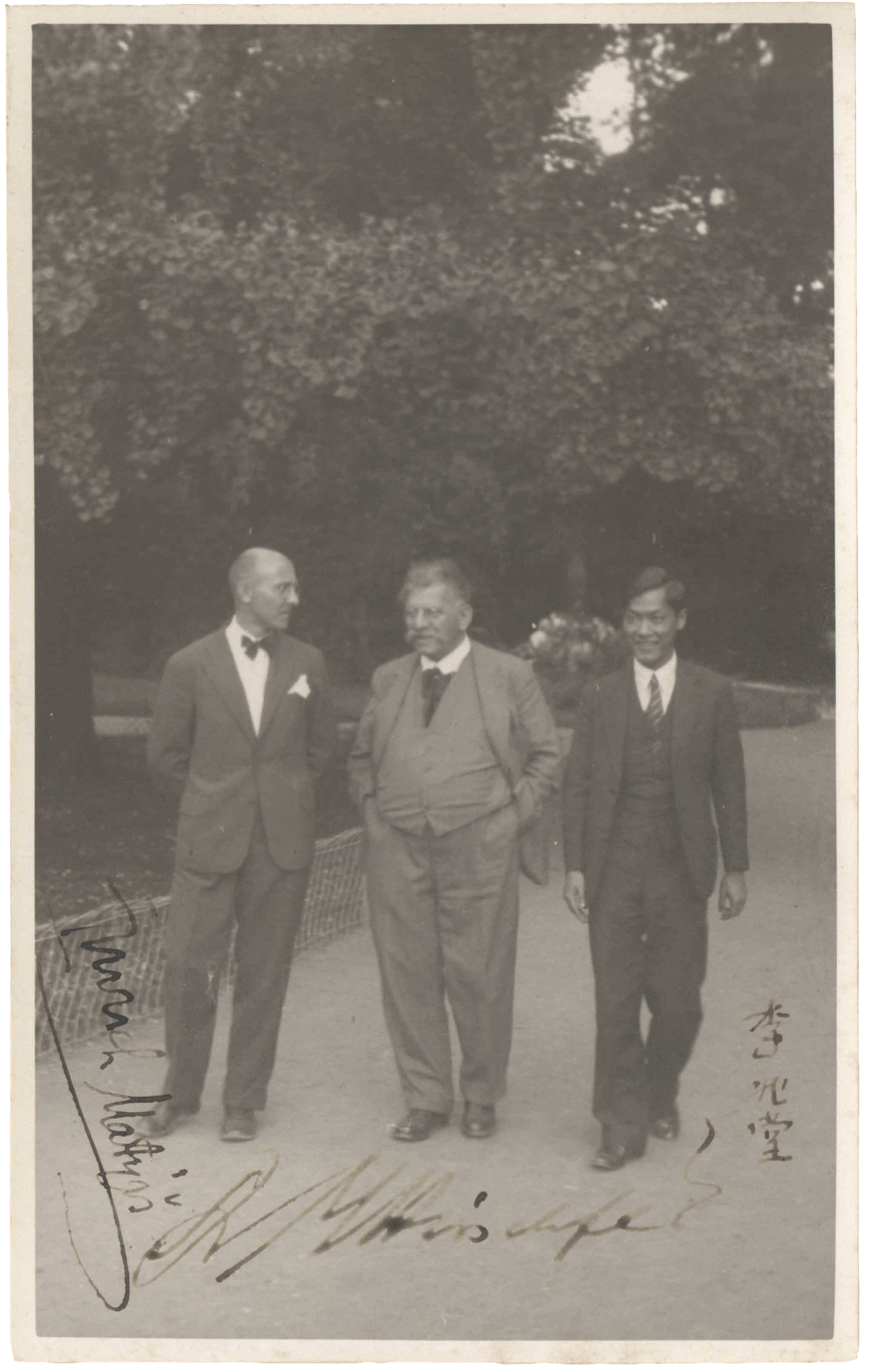
Among the most important personalities that Matyáš brought to the Bratislava environment was Magnus Hirschfeld – a German doctor, sexologist and one of the most famous pioneers of the queer emancipation movement. When Hirschfeld completed a lecture tour of Czechoslovakia, he visited Prague, Brno and Bratislava. Matyáš accompanied him on this occasion.
During one walk, Matyáš complained to Hirschfeld about queer people who didn't want to join the movement. Hirschfeld reassured him with a sentence that accurately captures the ethos of Hirschfeld's engagement:
"We must also free the inactive ones."
Even after Hirschfeld's death, Matyáš remained in contact with his close collaborator, Karel Gies. In a letter, the latter described the circumstances of Hirschfeld's sudden death and asked him, as the spokesman for the Czechoslovak movement, to spread this information among his people. Even from a foreign perspective, Matyáš was perceived as a person who had a circle, a network, and a community behind him.
Who were “his people”?
Who made up the Matyáš Circle? They were nameless friends from the local Bratislava community, but also specific people whose fates are gradually emerging from archives and photographs today. While researching a photograph from the spa in Ľubochne, I came across the names Mikuláš and Zoltán Klein, Béla Bárdos and Ferencz Bodó. The search for their fates led me to the Klein relatives in Israel. Thanks to them, I was able to obtain further information and photographs that also include Matyáš.
The stories of these people show that queer history is not just a history of identity. It is also a history of friendship, solidarity, loss, and attempts at rescue. During the war, Matyáš also tried to help Béla Bárdos and Ferencz Bodó, who were racially persecuted. Eventually, they were betrayed and deported to concentration camps, where they perished. After World War II, Matyáš wrote to Hiller that he had lost many friends from the community during the war and that he could not cope with it. His personal story is thus intertwined with the history of persecution, war, and post-war silence.
After the war: new regime, old pressure
After 1948, the Morality Department and State Security began to take an intense interest in Matyáš. They tried to get him to cooperate. For the regime, homosexual people were potentially blackmailable and therefore usable in various political games.
Despite the pressure, Matyáš did not stop his educational activities. He continued to organize private lectures on homosexuality and wrote letters to the leadership of the Communist Party. He reminded its representatives of the promises from the 1930s that if they came to power, they would repeal the articles punishing same-sex relations.
However, in 1950, the criminal legislation in Czechoslovakia was unified and Section 241 became applicable to the entire republic. It punished same-sex intercourse between men and women. Matyáš's efforts became even more isolated, but they did not stop.
Human progress, not total victory
In the 1950s, Matyáš again approached scientific authorities and sought support for a change in the law. In 1961, partial decriminalization did indeed occur: the criminalization of voluntary same-sex intercourse between adults over the age of 18 was abolished.
Matyáš wrote in his diary that day that it was a humane progress, but not a complete victory. His proposals also included a demand to punish acts of hatred against homosexuals. That is, acts that did not become criminal in Slovakia until many decades later.
This detail shows that Matyáš was not just thinking about repealing one paragraph. He was thinking about broader protection of the dignity, safety, and rights of people who had been subjected to hatred and blackmail for a long time.
Will in notebooks
During the 1960s, Matyáš decided to write down his memories of activism. He called them his will. According to one of his acquaintances, he distributed these notebooks to several members of the small queer community in Bratislava, which met in certain businesses. I met one of them in person. He told me that he and other younger people no longer understood Matyáš. They didn't understand why he was so concerned about preserving the memories of the interwar queer movement and its struggles. Despite this, he kept some of the diaries and testimonies at home for decades. In 2013, he contacted me and gave me two more volumes of Matyáš's notebooks.
After a newspaper article, relatives of Matyáš's sister contacted me. I learned that almost nothing of Matyáš's inheritance was left in the family. His writings, books, photo albums, paintings and other things had been thrown away or sold off. In 1974, after being diagnosed with an eye disease that would lead to blindness, Matyáš committed suicide in his apartment. He was cremated and his urn was never collected. His ashes were scattered in the scattering meadow of the Bratislava crematorium the following year.
Why Matyáš matters
When I was preparing exhibitions about Imrich Matyáš in 2014 and 2020, people from the queer community wrote to me that it was a shame that they didn't know his story when they were growing up. It would help them to know that they are not alone, not only in the present, but also in the past.
This is what makes Matyáš's story so important. It refutes the idea that queer people only appeared in Slovakia after the fall of the Iron Curtain or that "it all came from outside." It shows that there were people in our country who thought, wrote, organized, helped each other, and fought for dignity long before 1989.
The research on Imrich Matyáš is not over yet. For example, quite recently I identified him in a photograph in the collections of the Magnus Hirschfeld Gesellschaft, which until then had not been correctly identified or dated. So even after years, new clues are still emerging.
At the same time, it is becoming increasingly clear that Matyáš's story deserves a book form. Not just as a biography of one man, but as the story of an entire community that has long been repressed from public memory. And perhaps also as a reminder that the history of rights and dignity does not arise by itself. Someone has to write it, carry it, preserve it, and pass it on.
Imrich Matyáš did this almost his entire life.