"First" again and again
Every now and then, someone will appear in our space with an idea for a new act of activism. Something that hasn't been here before, something that can bring people together, create a safer environment, give a name to an experience, or move the public discussion forward. That's how Ganymedes was founded in 1990, the first Slovak association focused on defending the rights of homosexual citizens, associated with the names of Marián Vojtek, Ivan Požgai, and other activists. That's how Museion was founded in 1994, the first lesbian association in our region, founded by Hana Fábry. That's how Rainbow Pride was later born, also associated with Romana Schlesinger, or the first queer theater Nomantinels, founded in 2010 by Andrej Kuruc.
We could find many more similar examples. Behind them were always people who decided to bring something to life that they believed in. Something that was supposed to continue, grow, and contribute to the struggle for human dignity.
Why it's worth knowing your own history
People who have been involved in activism for a long time sometimes – for reasons of pure mental hygiene – make fun of who will come up with the next idea for something new, unique and especially “first”. As if it were a shame to continue the efforts of those who came before us. As if we cannot take their experience, wisdom, but also the lessons from their mistakes and human imperfection.
In an effort to always be the first, we often start over. We do not know our own history, we lose continuity and we slacken in community reflection and self-reflection. And that is a shame. It is long-term, ongoing and cultivated efforts – the awareness that we are not a lonely beginning, but part of a longer line – that can lead to the changes we want.
When we look at the history of homosexual emancipation and the struggles of LGBT people for their rights, we find that many of the things we thought up five, ten, or twenty years ago had already been done by someone else before us. These firsts are also unique in that they did not need to call themselves first. They used other words more often: modern, progressive, scientific, humanistic, and just.
When science merged with humanity
In 1897, the first association in the world to focus its efforts on defending people of homosexual orientation and ending their criminalization was founded in Berlin. It was called the Scientific-Humanitarian Committee (Wissenschaftlich-humanitäres Komitee) and was founded by physician and sexologist Magnus Hirschfeld, publisher Max Spohr, lawyer Eduard Oberg, and writer Franz Joseph von Bülow.
The name of the committee was not accidental. Its representatives built their argument on two pillars: scientific knowledge and the humanistic idea of the dignity of every person. If homosexuality is a natural human trait that a person is born with and cannot be changed or “cured”, then it is scientifically unjustified to strive to eliminate it. It is also pointless and unjust to punish expressions of love and attraction between adults of the same sex if they are based on mutual consent and do not harm anyone.
This was a radically modern idea at the end of the 19th century. The committee initiated a petition to repeal the German Section 175, which punished sexual relations between men. The petition was signed by prominent figures, including Albert Einstein, Thomas Mann, Hermann Hesse and Leo Tolstoy. In addition, the committee defended people prosecuted under this section in court, organized educational lectures for the public and published the professional journal Jahrbuch für sexuelle Zwischenstufen.
The petition was submitted to parliament several times, but the committee failed to push for the repeal of the paragraph. Nevertheless, it achieved something fundamental: it opened a public debate on a topic that had not been discussed to such an extent until then.
The First Institute of Sexual Science
In 1919, Magnus Hirschfeld founded the Institute for Sexual Sciences (Institut für Sexualwissenschaft) in Berlin, the first institution of its kind in the world. The institute provided a base for scientists, doctors, psychologists, and other professionals who dealt with human sexuality, gender, intimacy, and reproductive health. It also housed the Scientific-Humanities Committee.
It included a well-stocked library, archives, and collections of anthropological and cultural artifacts that documented various forms of sexuality across history and geographic regions. The institute also had a very practical dimension: it provided counseling for married couples, devoted itself to sex education, the prevention of sexually transmitted diseases, the emancipation of women, and the defense of civil rights for homosexual and transgender people.
It was visited by thousands of people a year and provided a large number of consultations. It was not just an academic institution. It was a place where scientific research met with concrete help for people who often had no one in society to turn to.
The Nazi destruction of one world
With Hitler's rise to power in 1933, the institute's activities were forcibly closed. Hirschfeld, a Jew, scientist, and advocate for the rights of sexual minorities, became for the Nazis an exemplary image of a person who, according to their propaganda, "undermines" the health and purity of the German nation.
On the morning of May 6, 1933, a group of students from the National Socialist Student Union stormed the institute. They shouted "Burn Hirschfeld!", attacked the employees present, and looted the premises. In the afternoon, the SA units completed the attack: they took over the building for their own needs and took away part of the library, archives, and collections.
A few days later, many of these materials ended up in flames during the infamous book burnings at Berlin's Opernplatz, now Bebelplatz. This was not just the destruction of an institution. It was an attack on memory, knowledge, and an emancipatory tradition that had been building up in Europe for decades.
Hirschfeld in exile
Hirschfeld was not in Berlin or Germany at the time. He was on a world lecture tour and never returned to his homeland. He settled in France, first in Paris and later in Nice. There, on May 14, 1935, his birthday, he died of a heart attack. He was 67 years old.
It must have been a huge shock for his closest friends and colleagues. He had been receiving congratulations in the morning, but as the day went on, wishes for a long life and good health turned into condolences. As if his sudden death had symbolically closed a great epoch of European emancipation efforts.
Not only did the man who the American press dubbed the “Einstein of Sex” during his tour die that day, but an extraordinary reformer, scientist, pioneer of the world’s first homosexual movement, passionate lecturer, advisor, and co-writer of the first film to feature a homosexual character – Anders als die Andern (Different from the Others) from 1919 – also died.
Hirschfeld and Czechoslovakia
Hirschfeld became a model for similar emancipatory efforts beyond Germany's borders. Today we might call him a charismatic public intellectual or even an influencer of his time. In the 1930s, he also lectured in Czechoslovakia - in Prague, Brno and Bratislava.
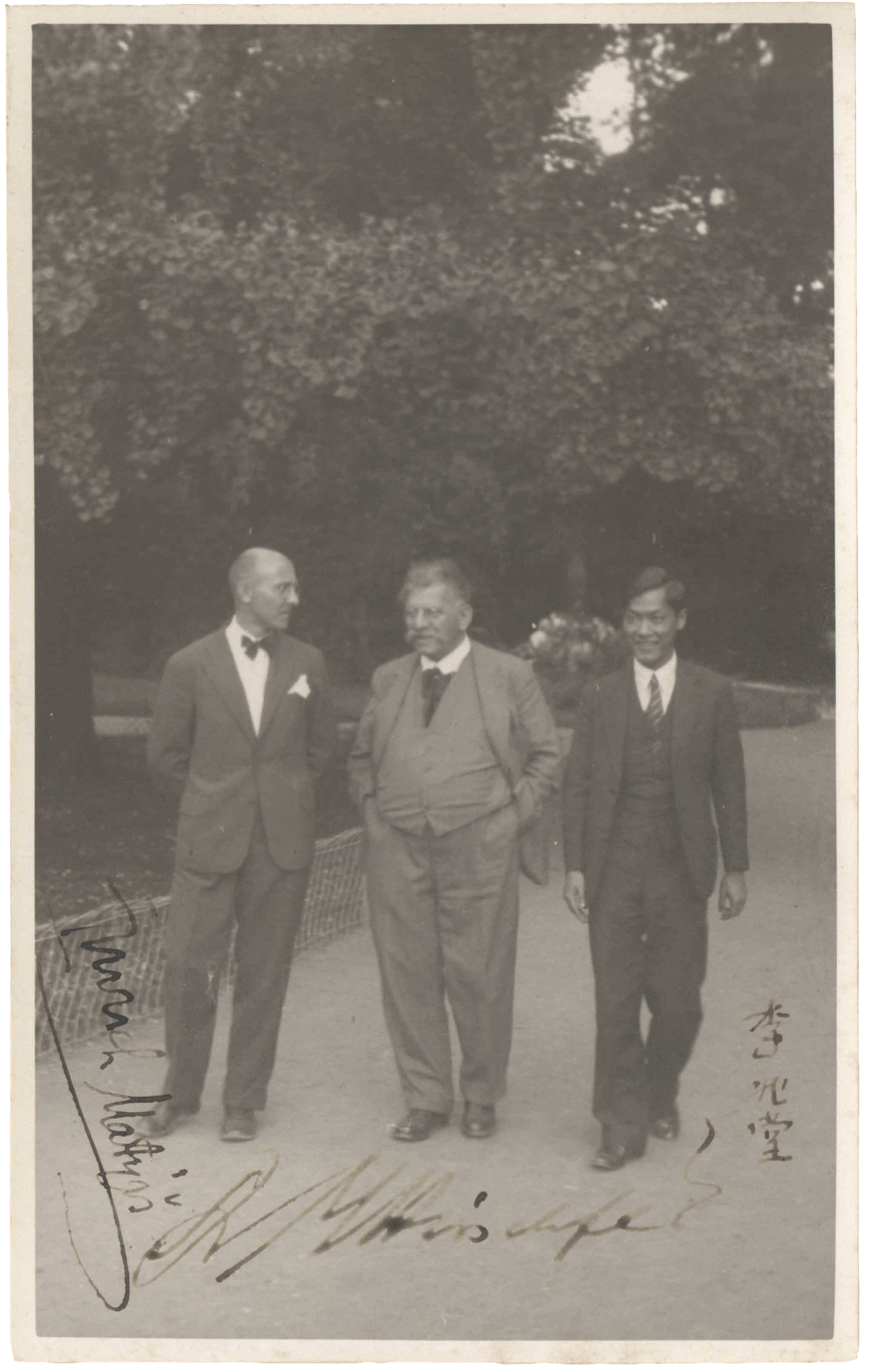
He was invited to Bratislava by Imrich Matyáš, a Slovak official, publicist and one of the first domestic actors in the effort to decriminalize homosexuality. Hirschfeld lectured in the small hall of the Reduta about his research, homosexuality and the need to repeal criminal sections.
Later, when they were walking together in the park, Matyáš complained to Hirschfeld that many homosexuals were not interested in getting involved and joining the efforts of the Prague or Bratislava “minority groups”. Hirschfeld certainly understood these reproaches – he himself must have experienced similar disappointments often. However, he replied with a sentence that went beyond the specific situation: “Despite everything, we must also free those who are inactive.”
The Shadow of Suicide
In Bratislava, Hirschfeld gave an interview to a local newspaper. In it, he also spoke about the constant presence of the "shadow of suicide" on his travels:
"It won't give me a moment of peace, I have to stand up for the liberation of homosexuals who suffer innocently and how many suicides there are, of whom we have no idea that the cause of suicide is their unchangeable condition. Homosexuality is not a disease. It is my duty to work with all my strength and energy for the benefit of homosexuals and to put an end to this tyranny. The youth understand me!"
These words show that Hirschfeld's efforts were not merely academic. They were based on an awareness of the concrete suffering of people who lived under the pressure of shame, fear, blackmail, criminalization, and social rejection. For him, science was an instrument of justice. Not dry expertise, but a path to a more dignified life.
The light that will return one day
From his French exile, Hirschfeld wrote a letter to Matthias, reflecting on Hitler's rise to power and the destruction of the world he had helped build. Even in these dark times, however, hope did not completely abandon him. He believed that "the light that radiated from Germany to the whole world - and today a period of darkness has come there - will one day return to Germany."
Hirschfeld did not live to see this happen. However, his legacy did not disappear. Others continued it and continue it to this day – including the activities of the Magnus Hirschfeld Gesellschaft in Germany, which is dedicated to researching, commemorating and making this tradition accessible.
Continue instead of starting over
We no longer have to strive to be first or second. It is enough to know that we are following in the long tradition of people who, before us, sought language, arguments, courage and institutions for the struggle for dignity. In Germany, it was significantly co-created by Magnus Hirschfeld. In Slovakia, it was continued by Imrich Matyáš.
Many of what we need today have already been mentioned before us: the need for scientific arguments, the need for solidarity, the need for safe spaces, the need for public advocacy, and the need to remember our own history. Including Matyáš's emphasis that this is not a "homosexual struggle" in the narrow sense of the word, but an ethical struggle for the very essence of democracy.
So when we talk about our European “Stonewalls,” we don’t have to look for just one moment of resistance. We can also see a long line of work, writing, speaking, organizing, counseling, and mutual support. It is in this that we see that the history of queer emancipation is not just a history of persecution. It is also a history of courage, perseverance, and the ability to keep going, again and again.


